
Introduction
Finding the “sweet spot” for your crane machine is an art form. If the grip is too weak, players feel cheated and stop playing. If it’s too strong, your inventory disappears faster than your profits can keep up. Adjusting claw strength correctly is the most important technical skill a route operator can master.
1. Understanding Voltage and Grip
Most modern claw machines in 2026 use a two-stage or three-stage strength setting:
Pickup Strength: The initial grip when the claw closes on the prize.
Carry Strength: The tension maintained while the claw moves toward the prize chute.
Drop Strength: The “retention” setting that determines if a prize is dropped prematurely.
2. How to Access the Settings
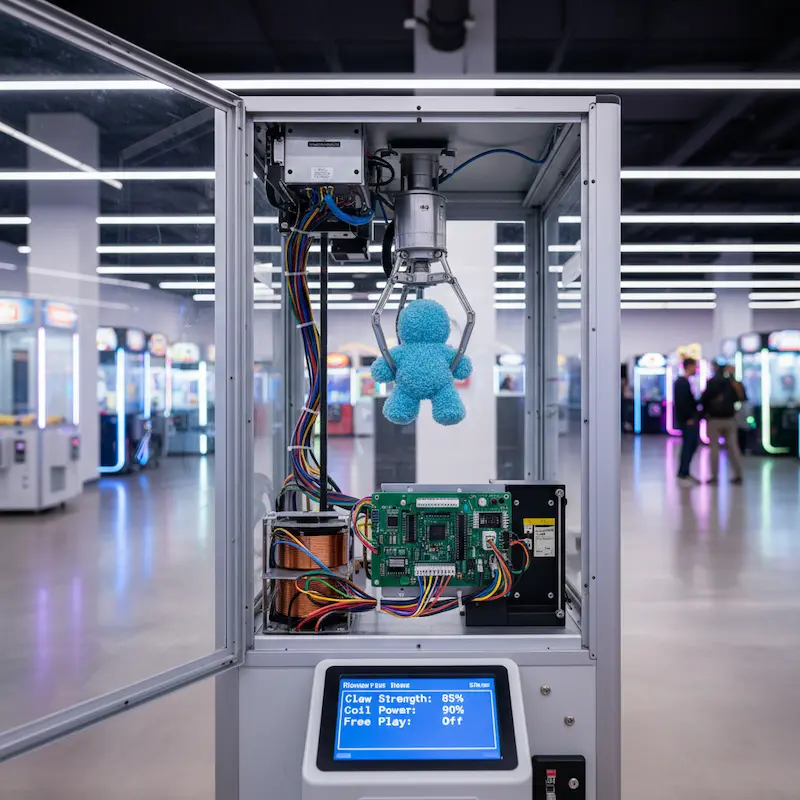
Most digital machines require you to enter the “Service Menu” via the internal PCB (Printed Circuit Board).
Locate the Menu/Enter button inside the coin door.
Navigate to “Power Settings” or “Claw Voltage.”
Adjust the voltage (usually on a scale of 1–100 or 1–50V).
3. Calculating Your Payout Ratio
In 2026, many machines offer “Auto-Calibration.” You input the cost of the prize (e.g., $1.50) and your desired profit margin, and the software adjusts the strength automatically. However, manual testing is always recommended.
The 3:1 Rule: Aim for the machine to “successfully” grab a prize once for every three to five plays, depending on your prize value and local regulations.
4. Common Troubleshooting Tips
If your claw feels “limp” even at high voltage:
Check the Coil: A burnt-out copper coil in the claw assembly will lose magnetic pull.
Inspect the String: Frayed strings can create friction, preventing the claw from closing fully.
Clean the Tips: Dirt or oil on the rubber tips of the claw can cause prizes to slip.
Conclusion
Mastering your machine’s settings ensures a long-term, sustainable business. For more tips on keeping your equipment in top shape, visit our Arcade Machine Maintenance & Troubleshooting Central.


 English
 Español
 简体中文
简体中文